
Are Cheap TEFL Courses Worth It?
19 Questions to Ask Before Choosing a TEFL/TESOL Provider
Thinking about becoming an English teacher? Before you buy a TEFL certificate, discover what makes a worthwhile qualification, why some courses cost so little and what employers actually expect.
The internet has made it easier than ever to obtain a TEFL/TESOL qualification. A quick search produces hundreds of providers, all competing for the attention of people who want to teach English abroad or online.
The choice can be bewildering.
Some companies advertise 120-hour qualifications for less than $50. Others charge several hundred dollars for courses offering similar numbers of training hours. Almost every provider claims to be accredited, internationally recognized or highly regarded by employers.
For someone new to the profession, distinguishing genuine educational value from marketing can be difficult.
With more than 25 years of experience in the international TEFL/TESOL industry, TEFL Online Pro’s founder, Neville David Thomas, has witnessed the market evolve considerably. He has also observed a growing number of providers competing for students, often with very different approaches to course quality, accreditation, support and business ethics.
I have also witnessed the growth of online training, the emergence of hundreds of new providers and the increasingly aggressive competition for students.
At TEFL Online Pro, we believe prospective students deserve clear information before making a decision. A low price does not automatically mean a poor course, just as an expensive qualification is not necessarily a better one.
What matters is the quality of the training, the standards behind it and the support available to students.
This guide addresses 19 questions worth asking before you spend your hard-earned money.

Part One: Understanding Cheap TEFL Courses
1. Why are some TEFL courses so cheap?
The growth of online education has made professional training more accessible.
Providers no longer need to maintain physical classrooms in multiple countries. Online delivery can substantially reduce operating costs, allowing companies to reach students around the world.
However, not every online course represents the same investment in educational content and student support.
Some providers operate with relatively lean business models. Others rely heavily on automated learning systems, limited tutor involvement or course materials requiring little ongoing development.
Some use exceptionally low introductory prices to lure customers, rarely showing the true cost of the course and the hidden costs.
There is nothing inherently wrong with offering discounts or operating efficiently. The important question is what the student actually receives.
Does the course have a properly developed curriculum? Are assessments meaningful? Is there access to tutors? Is the training maintained and reviewed? Can the accreditation be independently verifiable?
The advertised price tells you what a provider wants you to pay. It does not, by itself, tell you what the course is worth.
2. Can a genuine 120-hour TEFL course really cost less than $200?
This is one of the most important questions prospective students should ask.
My professional assessment is that it is extremely difficult to deliver a genuinely comprehensive, internationally focused 120-hour TEFL/TESOL qualification for less than $200 while maintaining the standards and services students should reasonably expect – and which reputable employers look for.
Consider what goes into operating a professional online training program.
There are costs associated with:
- Developing and maintaining a comprehensive training curriculum.
- Reviewing and updating course materials.
- Providing qualified tutors and meaningful student assistance.
- Maintaining reliable support across different time zones.
- Assessing students and administering certification.
- Certificate external moderation fees.
- Maintaining independent accreditation and meeting its requirements.
- Operating the website, learning platform and administrative systems.
- Supporting graduates after they have completed their training.
- An advertising budget.
- Taxes and other mandatory business expenses.
It raises an obvious question: which of these essential costs are cut by providers offering cheap TEFL courses?
These are not optional extras for a provider intending to deliver a serious educational service. They are part of the cost of running the business.
Even without the expense of renting and maintaining physical training centers, a company must generate sufficient revenue to pay for its people, systems, course development and ongoing obligations.
A provider offering all these services as part of a properly supported international 120-hour qualification would find it extremely difficult to operate sustainably below $200.
That does not mean every course advertised for less than $200 is necessarily poor. A temporary promotion – when it is only “temporary” – is not evidence of inadequate training, and different businesses have different cost structures.
But when a 120-hour qualification is advertised for $30, $40 or $50, prospective students should look beyond the headline price.
Ask what is included. Find out how much tutor support is available. Investigate the accreditation. Examine the curriculum.
A professional qualification should be judged by the quality of the training behind it, not by how little it costs to obtain a certificate.
3. Does a 120-hour certificate mean you have completed 120 hours of proper training?
Not necessarily.
The number of hours is a useful indicator, but it does not tell you everything about the educational value of a course.
A properly structured program should cover the essential foundations of teaching English as a foreign language. This includes grammar, language skills, teaching methodology, lesson planning, classroom management and the needs of learners from different backgrounds.
Students should also be assessed on their understanding of the material.
There is a significant difference between completing a structured training program and simply working through a collection of online pages until a certificate becomes available.
When comparing courses, look at the actual syllabus. Ask whether the material is sufficiently detailed, whether assessments test your knowledge and whether you can obtain help when you encounter difficulties.
The certificate may display a number of hours. The curriculum determines what those hours are worth.
4. Why does accreditation matter?
Accreditation can provide an additional level of assurance about the standards behind a training program.
However, the word itself is not enough. Prospective students should establish who the accrediting organization is, what it evaluates and whether its accreditation applies to the particular course they intend to purchase.
Accreditation, full accreditation and recognition are not the same thing. Accreditation indicates that a course or provider has been assessed against an accrediting organization’s standards, while full accreditation reflects the scope and status of that approval. The term “recognition” can be ambiguous and is sometimes used loosely. Neither basic accreditation nor a claim of recognition guarantees universal acceptance by employers or institutions.
Look for the name of the accrediting organization and investigate it independently. Do not rely solely on a provider’s own description of its credentials.
At TEFL Online Pro, all three of our TEFL/TESOL programs are fully accredited by ACTEFLC, an independent accrediting organization.
We consider this an important part of our commitment to professional standards. Accreditation should represent an ongoing responsibility, not simply a logo displayed on a website.
5. What should I look for when choosing an online TEFL course?
Before enrolling, I recommend considering eight areas.
Curriculum: Does the course cover the essential principles and practical foundations of TEFL/TESOL?
Accreditation: Is the accrediting organization identified clearly, and can you investigate its role independently?
Tutor support: Can you contact a tutor when you need assistance, or are you largely left to work through the material alone?
Assessment: Does the provider properly assess your understanding of the subject?
International relevance: Is the curriculum designed to prepare students for teaching English in different countries and educational environments?
Student service: Is someone available to help with administrative or technical questions?
Company history: How long has the provider been operating? Does it have a track record that can be checked?
Graduate support: Does the provider offer assistance after you complete the course?
A little research before enrolling can save considerable disappointment later.
At TEFL Online Pro, we promise that our experienced tutors will respond to you within 24 hours, often within a few hours at most. With us, you won’t be left in a holding pattern.
6. Are cheap TEFL courses necessarily the worst?
No. Price alone cannot establish the quality of a course.
Some reputable providers offer temporary discounts. Some have lower operating costs. Others offer shorter programs intended for people who already have teaching experience.
But there is a difference between a genuine promotional offer and a business model built around selling professional qualifications at exceptionally low prices.
My advice is to resist the temptation to choose a course simply because it is the cheapest available.
Compare the training, accreditation, tutor support and reputation of the provider.
A TEFL qualification is an investment in your future. It deserves more consideration than a quick comparison of prices.
Employers are increasingly alert to the limitations of bargain-basement TEFL courses. These often become apparent when candidates struggle to answer basic questions about teaching English or demonstrate their skills during a practical teaching interview.

Part Two: Choosing the Right TEFL Course
7. How many hours of TEFL training do I actually need?
For someone entering the profession, a 120-hour TEFL/TESOL qualification is the sensible starting point and the widely expected industry standard. Some positions also request additional practical teaching experience.
Employers recruiting English teachers internationally expect applicants to hold a certificate of 120 hours.
A 140-hour course incorporating teaching practice can also be a useful option for someone who wants additional preparation.
Does this mean that a course with 168, 250, 300 or 500 hours is automatically better?
Absolutely not.
Additional training can be valuable when it develops specific skills or provides meaningful practical experience. But a larger number printed on a certificate does not necessarily mean that a student is better prepared to teach.
The emphasis on increasingly large course-hour figures is little more than a marketing tactic. Students should ask what the additional hours actually involve and whether employers require them.
The objective should be to obtain the right qualification, not the qualification with the biggest number attached to it.
8. What courses does TEFL Online Pro offer?
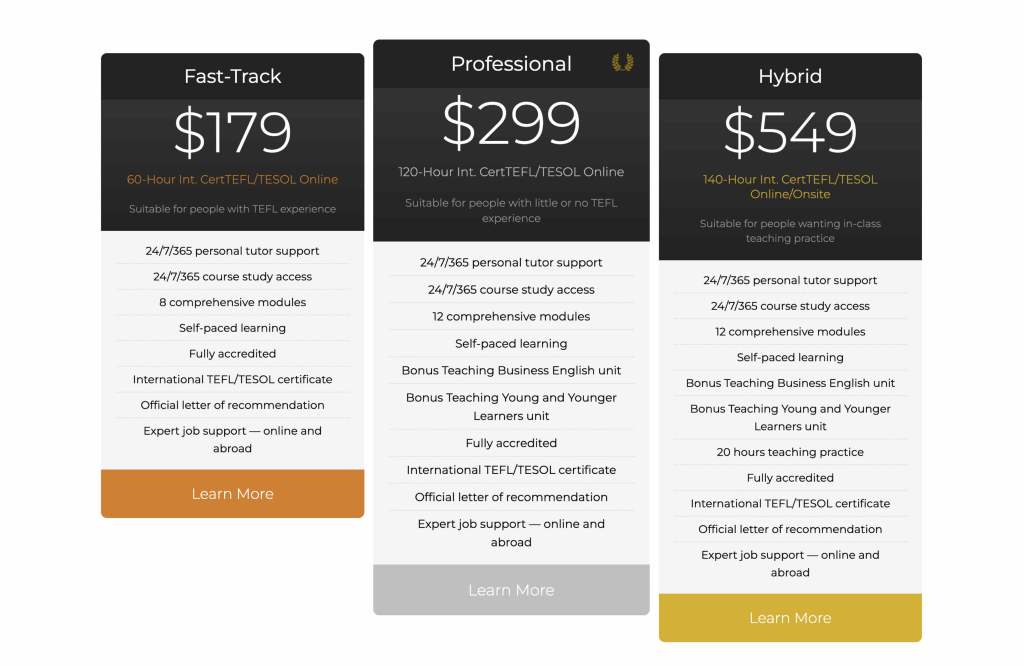
We offer three online TEFL/TESOL programs designed for different levels of experience and training objectives.
120-Hour Professional Course — Our Flagship Qualification
Our 120-Hour Professional Course is our flagship program and our most popular option.
It is designed for people seeking to enter the international English teaching market who want a comprehensive, professionally structured TEFL/TESOL qualification.
The 120-hour qualification reflects the level of training widely expected by employers recruiting new teachers.
We have kept its regular, undiscounted price at $299 since 2019. We occasionally offer promotional discounts, but our standard price has remained unchanged.
140-Hour Hybrid Course
Our 140-hour Hybrid Course is intended for students who want a teaching practice component included.
That practical component can be useful for graduates seeking positions where employers place particular emphasis on classroom experience.
As always, applicants should check the specific requirements of the employers and countries in which they intend to work.
60-Hour Fast-Track Course
Our 60-hour Fast-Track Course serves a different purpose.
It is particularly suitable for experienced English teachers who want to refresh their knowledge of key TEFL/TESOL principles or update their understanding of current teaching practices. For example, someone who has taught English without formal certification may find that, despite having valuable classroom experience, employers still require an internationally recognized TEFL/TESOL qualification.
For someone with little-to-no previous teaching experience, I would generally recommend the 120-hour Professional course.
A shorter refresher program should not be confused with comprehensive initial training.
We believe students should pay for the training they actually need. More hours are not automatically better, and fewer hours are not necessarily a problem when the course is designed for someone with existing experience.
9. What makes TEFL Online Pro different?
TEFL Online Pro was established in 2019 to provide accessible, professionally structured online TEFL/TESOL training for an international audience.
Since launching, we have trained more than 50,000 customers.
Our approach is based on several principles: a properly developed international curriculum, independent accreditation, accessible tutor support and assistance that continues beyond graduation.
We also believe that a training provider should be accountable for the claims it makes.
Prospective students should be able to establish who is behind a company, what its qualifications are and what services it actually provides.
Our business has grown in a competitive market, and we are proud of the standards we have worked to maintain.
10. Do TEFL Online Pro courses follow an international curriculum?
Yes. All three programs follow the international TEFL/TESOL curriculum.
English is taught in a wide range of countries, cultures and educational settings. A course intended for the international market should therefore give students a broad foundation rather than concentrating exclusively on the requirements of one local teaching environment.
Our training introduces students to the principles and methods involved in teaching English to learners from different backgrounds and ages.
We believe this provides a useful foundation for graduates as they pursue opportunities and gain experience in the classroom, abroad or online.
11. Is tutor support really available 24 hours a day?
Yes. TEFL Online Pro provides 24/7/365 online tutor support.
This matters because our students are spread across different countries and time zones.
A student studying in Asia may need assistance when it is the middle of the night in Europe or North America.
We do not believe that online education should mean learning alone. Students should be able to seek help when they need it, rather than having to wait for a conventional office to open.
Round-the-clock support also requires resources. It is one of the services prospective students should investigate when comparing course prices.
12. Will a TEFL Online Pro certificate be accepted by employers around the world?
Our programs are designed for the international TEFL/TESOL market, follow the international curriculum and are fully accredited by ACTEFLC.
With one exception involving a graduate who was already employed by a competing provider when she enrolled in our course, we have not had a graduate report being unable to find an English teaching position after completing their training with us.
The quality of our training equips TEFL Online Pro graduates to compete for teaching positions at reputable language schools, universities and other educational institutions, where professional qualifications and teaching competence are highly valued.
Government regulations and visa requirements vary from country to country. As part of our free support service for TEFL Online Pro graduates, we provide guidance on visa requirements and the documentation typically needed to teach abroad. We nevertheless encourage graduates to check the latest regulations with the relevant authorities and confirm that their nationality and circumstances make them eligible to live and work in their chosen country.
We provide a professionally developed, fully accredited qualification with globally recognized certification, equipping graduates to pursue international English teaching opportunities, both abroad and online.
13. Does TEFL Online Pro provide support after graduation?
Yes. We provide lifetime job support to our graduates.
Completing a qualification is an important achievement, but it is often only the beginning of the process.
Graduates may have questions about entering the job market, preparing applications or identifying suitable teaching opportunities.
We believe support should not end when the final assessment is completed.
Our lifetime job support is part of the service we offer to graduates.
When comparing providers, it is worth checking whether post-course assistance is genuinely available or whether the relationship effectively ends when the certificate is issued.
We strongly recommend exercising caution when choosing TEFL programs that advertise guaranteed job placement. Some providers have referral arrangements with overseas schools, under which graduates are placed in teaching positions and a percentage of their monthly salary is returned to the TEFL provider as a commission. In some cases, the actual working conditions may differ considerably from what candidates were originally promised. We believe graduates should retain control over their job search and have the freedom to choose employers and positions independently, without undisclosed financial arrangements influencing their placement.
14. Has TEFL Online Pro received any industry awards?
Yes. TEFL Online Pro received the Teachers’ Choice Award from Trusted TEFL Reviews for eight consecutive years, from 2019 through 2026.
We are incredibly proud of this recognition.
Building a training business requires sustained effort, and receiving the award year after year is an achievement we value.
An award should not be the only reason to choose a course. It should be considered alongside the curriculum, accreditation, student support and the provider’s track record.
Part Three: Reviews, Competition and Transparency
15. Why has the TEFL industry become so competitive?
The online TEFL/TESOL market has grown considerably.
New providers can establish a website, advertise internationally and begin selling courses without the infrastructure traditionally associated with a training organization.
That has created more choice for students. It has also made it harder to distinguish established providers from businesses with little experience of the industry.
Competition is not inherently a bad thing. It can encourage companies to improve their courses, develop better services and offer competitive prices.
But competition should be based on the quality and value of what companies provide.
Problems arise when the focus shifts towards misleading advertising, undisclosed commercial relationships or attempts to damage the reputation of competitors through inaccurate online commentary.
After more than 25 years in this industry, our founder understands that reputation is one of a company’s most valuable assets.
It takes years to establish credibility and considerably less time for misleading information to undermine it.
We have therefore decided that, where we believe our business has been misrepresented, we should respond with evidence rather than remain silent.
16. Can I trust online TEFL reviews?
Online reviews can be useful, but they should be approached with the same critical judgment you would apply to any other commercial recommendation.
Consider the following:
- Does the reviewer appear to have completed the course?
- Is the review published on an independent platform?
- Does it describe specific aspects of the training experience?
- Is any commercial or promotional relationship disclosed?
- Does the review offer a balanced account, or does it read more like an advertisement?
- Does a company receive an unusually large influx of reviews over a short period?
An increasingly concerning trend is the practice of some providers flooding review websites with positive reviews, particularly those with limited verification procedures. On closer examination, some of these reviews may appear to have been written or commissioned by the providers themselves rather than by independent students.
It is also important to consider the wider pattern of reviews rather than allowing one particularly positive or negative comment to determine your decision.
The relationship between review websites, commercial promotion and training providers is not always as straightforward as it appears.
Students should be aware that some people who recommend or criticize businesses may have professional or commercial connections that are relevant to their comments.
Reviewers should also understand what verification labels actually mean. On some review platforms, such as Trustpilot, the “Verified” label may indicate that an email address or review invitation has been verified, rather than independently confirming that the reviewer purchased a course or was genuinely a student of the provider.
We have examined these issues in material published on our own review website.
Read more: TEFL Online Pro Reviews:
https://tefl-online-pro-reviews.com/
Our position is simple: readers deserve to know when a recommendation is commercially motivated.
17. What are brand ambassadors, and why does transparency matter?
A brand ambassador is someone who promotes a company, product or service.
There is nothing inherently wrong with this arrangement. Businesses have every right to work with people who support their products.
The issue is disclosure.
If someone has a commercial relationship with a training provider, readers should be able to take that into account when evaluating their recommendations or criticism of competing companies.
This is particularly important in the TEFL industry, where prospective students may rely heavily on online reviews and discussions when deciding where to spend their money.
We have published an examination of brand ambassador relationships and promotional activity in the TEFL review market, including examples that we believe deserve closer scrutiny.
Read more: Hidden Brand Ambassadors & TEFL Reviews:
https://teflonlinepro.com/hidden-brand-ambassadors-tefl-reviews/
A disclosed commercial relationship does not automatically invalidate someone’s opinion
Nor does the existence of a brand ambassador relationship, by itself, establish that a particular review was commissioned or that a company directed someone’s criticism.
Those distinctions are important. Our concern is that readers should have access to relevant information and be able to make up their own minds.
18. Why did TEFL Online Pro publish a Transparency Report?
We published our Transparency Report because we believe prospective students and the wider TEFL community deserve a clearer picture of how the online market operates.
Over time, we encountered online claims, promotional relationships and review activity concerning our business and the wider industry that we believed warranted examination.
We could have ignored the material or responded with general accusations of our own.
Instead, we chose to document the issues we had identified, provide supporting material where available and explain why we considered them relevant.
The report addresses online promotion, review activity, brand ambassador relationships and other matters affecting how TEFL providers are represented online.
It includes documentary material, including examples of promotional activity on Reddit. We believe this material is relevant to a discussion about the distinction between independent commentary and commercially connected promotion.
We are careful to distinguish what the evidence demonstrates from what it does not.
For example, evidence that an individual has acted as a brand ambassador does not, on its own, prove that a company commissioned a particular criticism. Similarly, a commercial relationship should not automatically be treated as proof that every opinion expressed by that individual is insincere.
We believe that presenting the evidence, explaining its limitations and allowing readers to draw their own conclusions is a more responsible approach than making unsupported allegations.
Read the TEFL Online Pro Transparency Report:
https://teflonlinepro.com/transparency-report/
We did not publish this report simply to criticize competitors.
We published it because transparency matters in an industry where people are making important decisions based on information they find online.
19. Why should I choose TEFL Online Pro?
Choosing a training provider is a personal decision. There are many companies in the market, and prospective students should take the time to compare their options.
We believe TEFL Online Pro deserves consideration for several reasons:
- Established in 2019.
- More than 50,000 customers trained.
- Three TEFL/TESOL programs fully accredited by ACTEFLC.
- An international TEFL/TESOL curriculum.
- 24/7/365 online tutor support.
- Lifetime job support for graduates.
- The Teachers’ Choice Award for eight consecutive years, 2019–2026.
- More than 25 years of industry experience behind the business.
- A commitment to professional standards and transparency.
There is another point worth emphasizing: we have maintained the regular price of our flagship 120-Hour Professional course at $299 since 2019.
That is our standard, undiscounted price—not a temporary promotional offer.
We do occasionally offer discounts, but our regular price has remained the same for more than seven years, despite increases in the costs of operating a business.
Our online business model helps us maintain this price. We do not carry the rental and maintenance costs associated with operating a network of physical training centers.
Instead, we can concentrate our resources on curriculum development, accreditation, tutor support and the services our students and graduates need.
We believe professional training should be accessible. But accessibility should not mean compromising the quality of the education or the support provided.
If you are considering a career in teaching English, take the time to investigate your options.
Remember that you are researching a qualification in a highly competitive market, where misinformation, misleading claims and aggressive marketing are not uncommon. Look beyond the advertised price. Examine the curriculum, verify the accreditation, ask about tutor support and find out what happens after you graduate. Don’t take a provider’s claims at face value; do your own research before making a decision.
A good decision begins with asking the right questions.
Explore TEFL Online Pro courses and enroll:
https://teflonlinepro.com/enroll/
Cheap TEFL Courses: A Final Word
The TEFL/TESOL industry has changed considerably over the past quarter-century.
Online education has opened doors for people who might otherwise never have had the opportunity to obtain a teaching qualification or pursue an international career.
That is something worth protecting.
But the growth of the market has also made it more important for prospective students to distinguish between a properly developed training program and a certificate being sold primarily on price.
A qualification is not just a document. It represents the training, knowledge and preparation that stand behind it.
After more than 25 years in this industry, our founder remains convinced that students deserve a serious curriculum, meaningful assessment, accessible tutors and a provider prepared to stand behind its work.
That is what we have worked to offer at TEFL Online Pro since 2019.
Thank you for taking the time to read this Are Cheap TEFL Courses Worth It? guide. I hope it helps you make a well-informed decision about your training and your future in English language teaching.
Paul Murphy
Operations Manager
TEFL Online Pro
info@teflonlinepro.com
https://teflonlinepro.com/enroll/
The Teachers’ Choice Award winner: 2019–2026
About the Founder
TEFL Online Pro was founded by Neville David Thomas, an Oxford (England) alumnus with more than 25 years of experience in the international TEFL/TESOL industry. His professional background includes founding English language schools, establishing on-site and online TEFL/TESOL certification programs, and contributing published articles to Cambridge University Press. His experience spans teacher training, curriculum development, educational management and the international English language teaching market.
Outside his work in teacher training, Neville writes about literature, history, philosophy and other subjects on his personal website, nevilledavidthomas.com. He is also a keen long-distance walker, with a particular interest in exploring places and cultures on foot.


