
By Neville David Thomas
Political scientist Wallace Sayre is usually credited with a remark about university politics: the infighting is so bitter because so little is at stake. Nobody is battling over an empire. People fall out over a parking space, a footnote, or the order of names on a paper that a handful of readers will ever open.
That remark kept coming back to me as I looked at a run of events in the online TEFL industry. The money that may have motivated some of the activity described below was modest, perhaps $20–60 for a course sale made through an affiliate link. The fallout for other people was far larger.
Before you read on: I own TEFL Online Pro This is not a neutral article. It is my account of a dispute involving my own company, and it condenses the evidence we collected in our full Transparency Report. Please weigh that evidence yourself rather than relying on my summary. One clarification up front: some claims online say that we own ACTEFLC. They are false. TEFL Online Pro does not own ACTEFLC, which is an independent accrediting body.
Background: the companies involved
TEFL Online Pro has provided online TEFL/TESOL certification since 2019. Our courses are accredited by ACTEFLC, the Accreditation Council for Teaching English as a Foreign Language Courses. More than 50,000 graduates have trained with us worldwide, and we have won the Teachers’ Choice Award eight times.
Our main competitor is The TEFL Academy (TTA, operated by Everything TEFL LTD), which changed hands in 2021. Before that, we had no notable disputes with the company.
Since 2021 we have come across damaging online content about TEFL Online Pro written by people we understand to have commercial links with TTA’s Brand Ambassador program. In the content we identified, those links were not disclosed.
That is the starting point here. I am not arguing that competitors may never criticize one another; they should be free to. My argument is narrower: when commentary looks independent, readers deserve to know if its author has a relevant financial relationship.
I also think there is a wider pattern worth examining.
The “sicario” model: competition by proxy
The two cases below should not be read in isolation. In our experience, the trouble began after The TEFL Academy’s change of ownership. Since then we have had reason to ask whether affiliate and ambassador relationships are being used to attack a competitor while the company that might benefit keeps its distance.
I have started thinking of this as the sicario model of online competition. In Spanish, a sicario is a hired killer. I use the word purely as a metaphor: someone else carries out the attack, the commercial interests behind it may be invisible to the audience, and the company that may gain can disown whoever published the content.
The comparison is intentionally stark, so let me be clear about its limits. I am not saying every affiliate marketer behaves improperly, and I am not saying an ambassador relationship alone proves a company commissioned an attack. The question is whether the evidence in these cases points to a broader pattern of conduct.
Compare two situations. In the first, a company publishes a critical advertisement under its own name; readers know who is speaking and can factor in the commercial motive. In the second, an affiliate publishes what looks like an independent review; readers may assume they are hearing from a neutral observer, unaware of any tie to a rival provider.
The criticism is visible. The commercial connection may not be.
That gap is what could make the approach effective. Apparently independent content often persuades more readily than an obvious advertisement, and once a third party has published it, working out how far the company was involved becomes difficult.
A commercial relationship does not establish who commissioned, directed or approved a given publication. It is, however, a reason to look closely at the circumstances and to ask why the relationship was not disclosed.
The records we have gathered are set out in the Transparency Report. I invite you to read them and decide whether these episodes look like unrelated disagreements or something more connected.
Affiliate links and brand ambassadors: legitimate, if disclosed
Affiliate marketing is not a crime. It is an ordinary business model: a company pays a commission when a referred customer buys, and a content creator earns money by recommending products, courses or services. Nothing is inherently wrong with that.
The problem begins when commercial content passes as independent opinion and the financial relationship stays hidden.
Advertising guidance in the UK and Ireland stresses that advertising and commercial relationships should be clearly identifiable. The exact obligations depend on the circumstances, the platform and the rules that apply, but the underlying principle is simple: readers should not have to dig into an author’s business ties to discover a relevant commercial interest.
TTA runs a Brand Ambassador program and has also advertised a commission-based affiliate scheme through ShareASale. Program material in our records indicates commissions of roughly 10–15% per sale, which could come to about $20–60 on a course, depending on price and terms.
Brand Ambassador material held in our records:


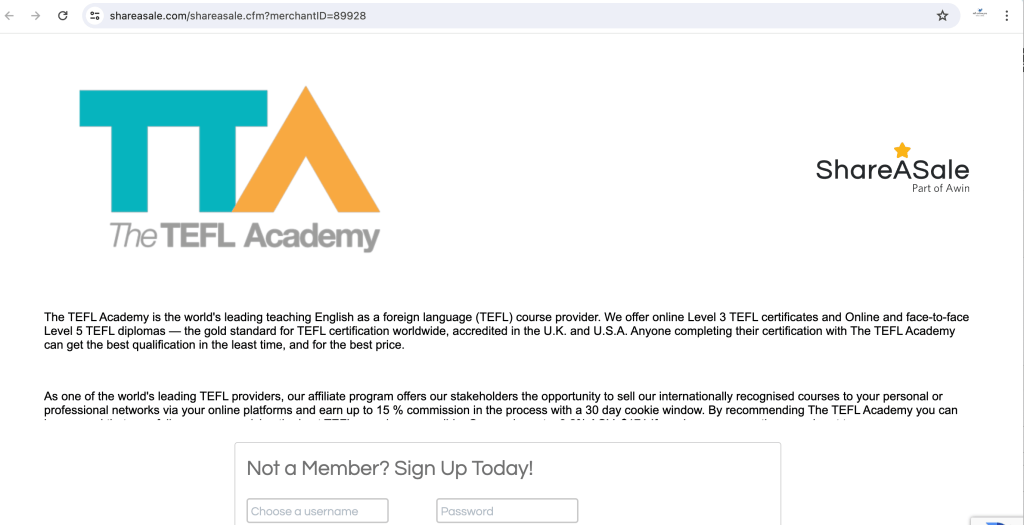
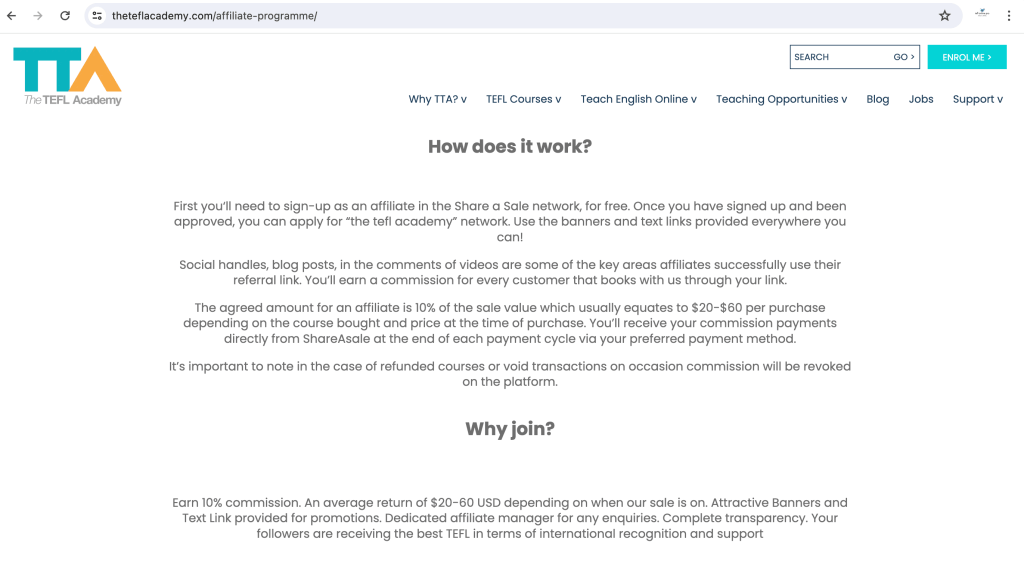
Twenty to sixty dollars. That is the possible financial incentive we are talking about.
It does not prove that money motivated anyone to write anything, and taking part in an ambassador program does not, on its own, show that an author was paid for a specific review. But it does raise an obvious question: if a writer has a commercial relationship with a competing provider, should readers be told?
I believe they should.
2021: a review that got a key fact wrong
In March 2021, the TPR Teaching website published a review of TEFL Online Pro headlined “TEFL Online Pro Review Warning: Is it Legit?”
According to material we collected, the author, Caitriona McTiernan, had a personal affiliate link connected to The TEFL Academy, and we also hold records linking her to TTA promotional content.
The review said there was no evidence that TEFL Online Pro was regulated or accredited. We dispute that. At the time, TEFL Online Pro held full ACTEFLC accreditation, and the supporting records are in our Transparency Report.


That comment stated: “Yes, TEFL Online Pro is a scam.” It is a serious accusation, and readers should be able to look at the context and decide whether the evidence offered supported it.
We found no affiliate disclosure on the review and none on the comment. Yet the same author did include an affiliate disclosure in the description of a YouTube video reviewing The TEFL Academy.
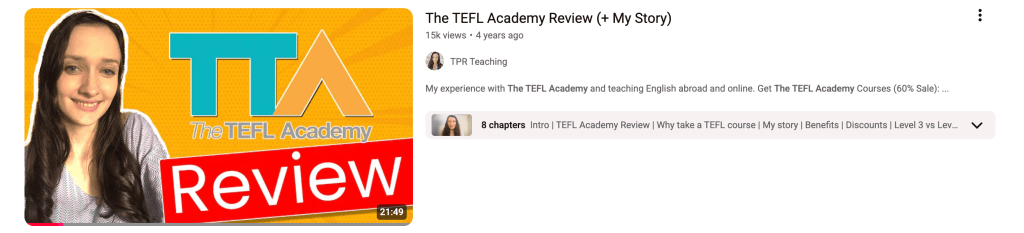
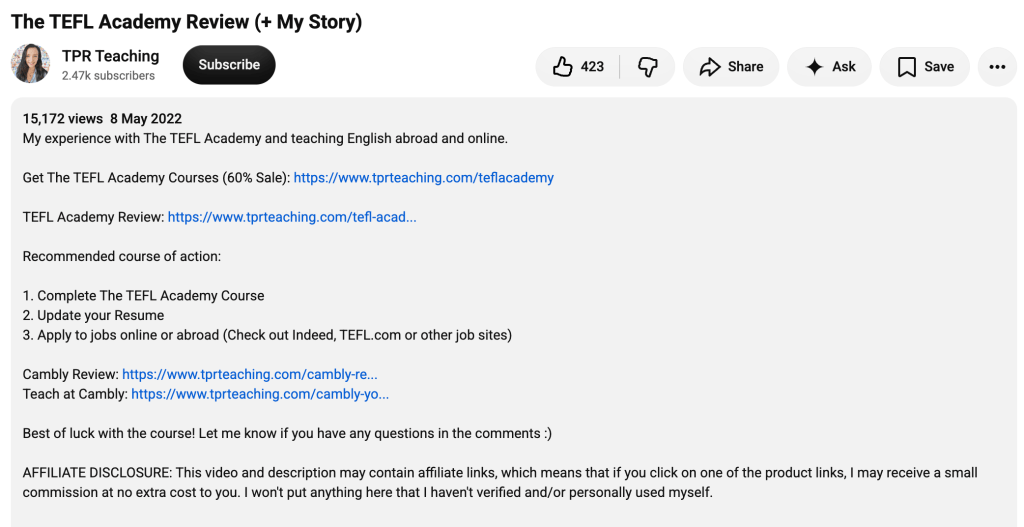
You can watch the video here.
The contrast matters. It suggests the author knew how affiliate disclosure works, even though we could not find a comparable disclosure on the material criticizing our company.
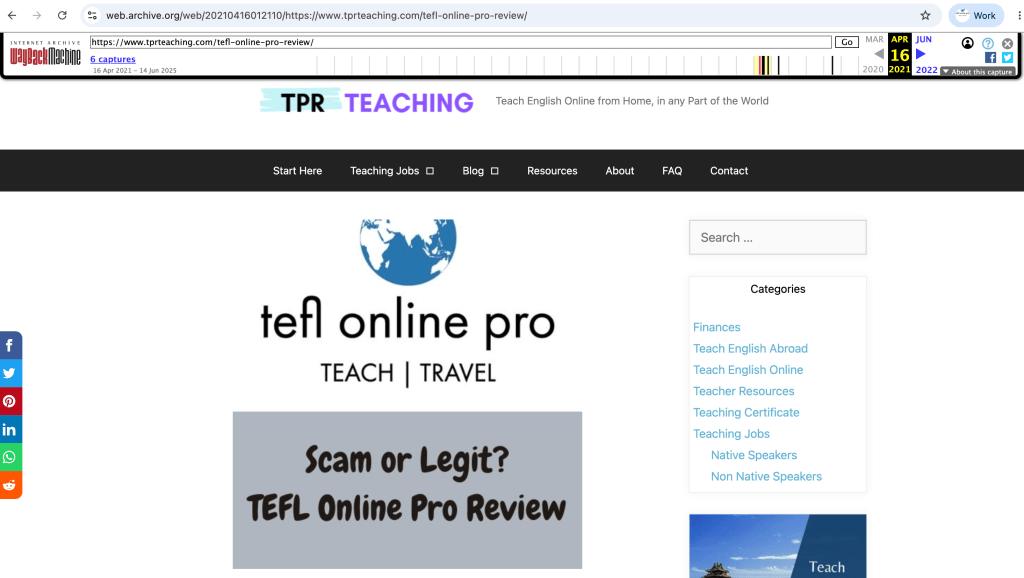
The TPR Teaching post was later taken down. We keep a Wayback Machine capture of the page from March 30, 2021.
We also asked The TEFL Academy about the YouTube channel. In emails from December 2022, TTA support first described the channel as belonging to “a creator we are unaware of.” Once we had identified the person, the reply said she “no longer works for company.”
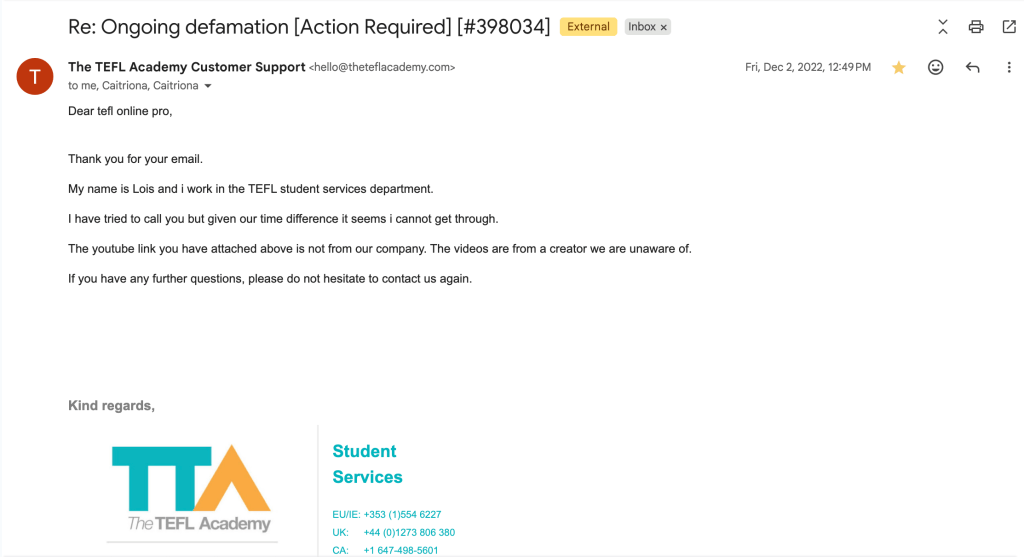

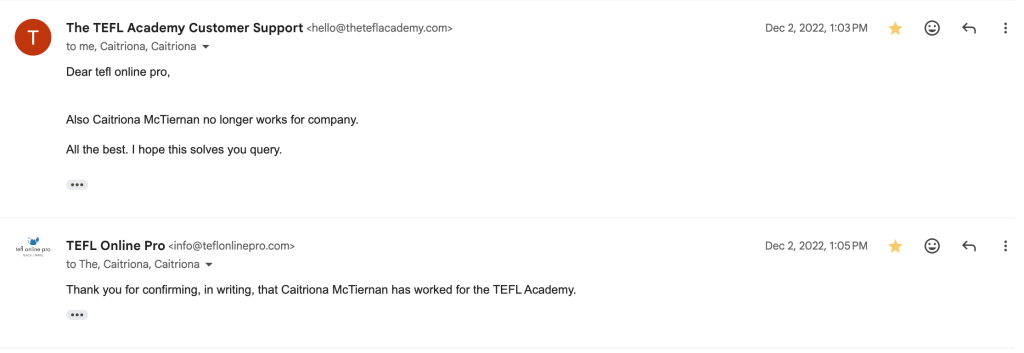
Those two answers are hard to reconcile at face value. They do not establish everything about the author’s relationship with TTA, but they form part of a documentary record that readers can examine.
To repeat the point: a Brand Ambassador need not agree with the company they represent, and an affiliate may criticize a competitor. What matters is that readers get to know about any relevant commercial connection when judging a supposedly independent review.
2024: the Reddit thread
In October 2024 a customer finished our 120-hour TEFL course. Our records show she completed it in the morning and that her certificate was issued the same day. She later opened a PayPal chargeback, which was resolved in TEFL Online Pro’s favor.
Two days after the certificate was issued, a long Reddit post appeared claiming that we had threatened her and sent fabricated emails.

Source: Megan Broccoli’s original Reddit post.
We dispute every allegation in it. Our records show that our messages to the customer dealt with her payment, her completion and passing of the course, the issuing of her certificate and the chargeback. We deny sending the emails later shown as screenshots in the post.
These are contested claims, and readers cannot settle them by taking my word for it. That is why we kept the relevant records and set out our version in the Transparency Report.
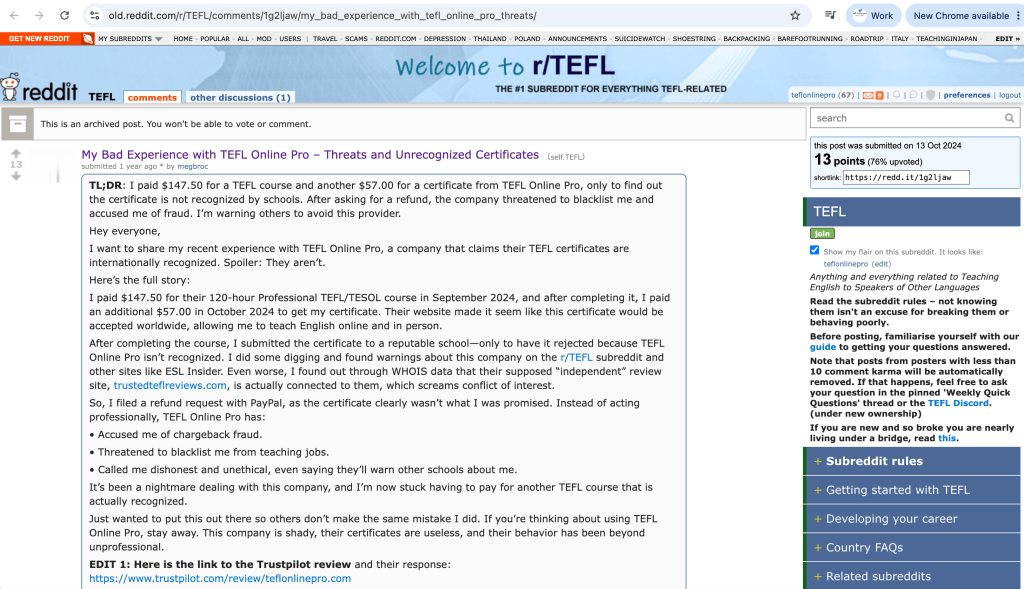
We also hold documentation that appears to connect the author with TTA’s Brand Ambassador program. The Reddit post did not mention any such connection.
Again, an ambassador relationship does not make every criticism invalid, and it does not prove the author was paid to write this particular post. It is context that readers should be able to weigh.
The thread is still circulating, and we have seen TEFL Online Pro mentioned in AI-generated search summaries. When automated tools condense online material, the original context and any undisclosed commercial ties can get lost. A claim can then resurface long after the original discussion, with readers unaware of where it came from or what supported it. Once an allegation has spread across websites, forums and search summaries, correcting the record is far harder than publishing the claim was in the first place.
Earlier disputes over Facebook reviews
My concern about review integrity in the TEFL industry has a longer history.
Soon after The TEFL Academy changed owners, I took a phone call from representatives of the company asking why TEFL Online Pro had so many five-star Facebook reviews. During that call I understood one of their later remarks as a verbal threat to manipulate our Facebook reviews by posting negative comments. As far as I know, The TEFL Academy never acted on it.
Separately, I hold screenshots of messages I took to be threats to post negative reviews of TEFL Online Pro, involving ITT International TEFL and TESOL Ltd. I regard those messages as serious and relevant to the question of whether reviews can be manipulated for commercial ends.
Please keep three things apart: the phone conversation as I recall it, the written messages that can be examined directly, and any conclusions drawn from either.
Threats, review manipulation and an attempt to silence criticism
My concerns do not rest only on the episodes above. In November 2022 I received emails from an account calling itself International TEFL and TESOL that contained explicit threats against the TEFL Online Pro website and its online reputation. The correspondence involved James Anthony Dwyer, who is associated with ITT International TEFL and TESOL Ltd. and with World TEFL Institute. I kept four screenshots that document the exchange.
Exhibit 1: a review of his own course. The first screenshot shows a review of Dwyer’s own TEFL course, posted under the alias “Paul” and accompanied by a photograph of Dwyer. I consider it relevant to the difference between independent customer feedback and promotion.
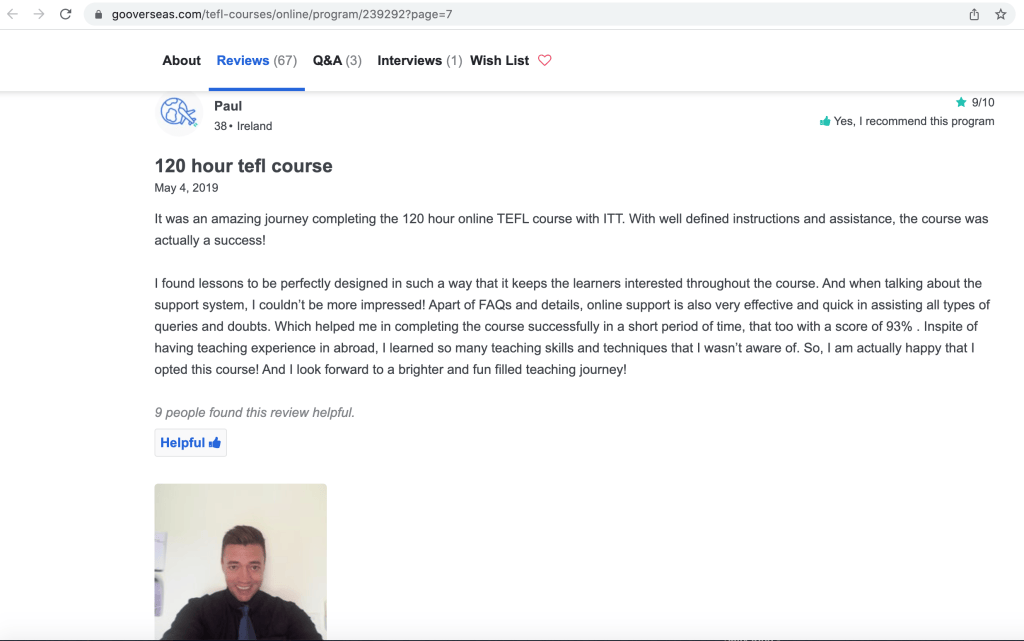
Exhibit 2: threats against our website. In an email dated 13 November 2022, Dwyer wrote that he already had a click farm clicking on TEFL Online Pro’s Google ads and threatened database takeovers and SQL injection of malware on teflonlinepro.com unless I removed two posts. The email made the threatened action explicitly conditional on my removing them.

Exhibit 3: threats about our Facebook reviews. In separate emails Dwyer threatened to undermine our Facebook reviews with negative comments. I later noticed negative review activity that I believe was linked to those threats, and I kept screenshots of both the emails and the reviews.

Exhibit 4: further correspondence. The fourth screenshot shows a longer exchange, running from November 2022 to May 2023. It includes more threats and a proposal that I remove critical posts, publish a favorable review of ITT International TEFL and TESOL and help promote its website. In return, the sender offered to remove comments, stop the alleged advertising activity and hold back the threatened action against our site. I did not accept.
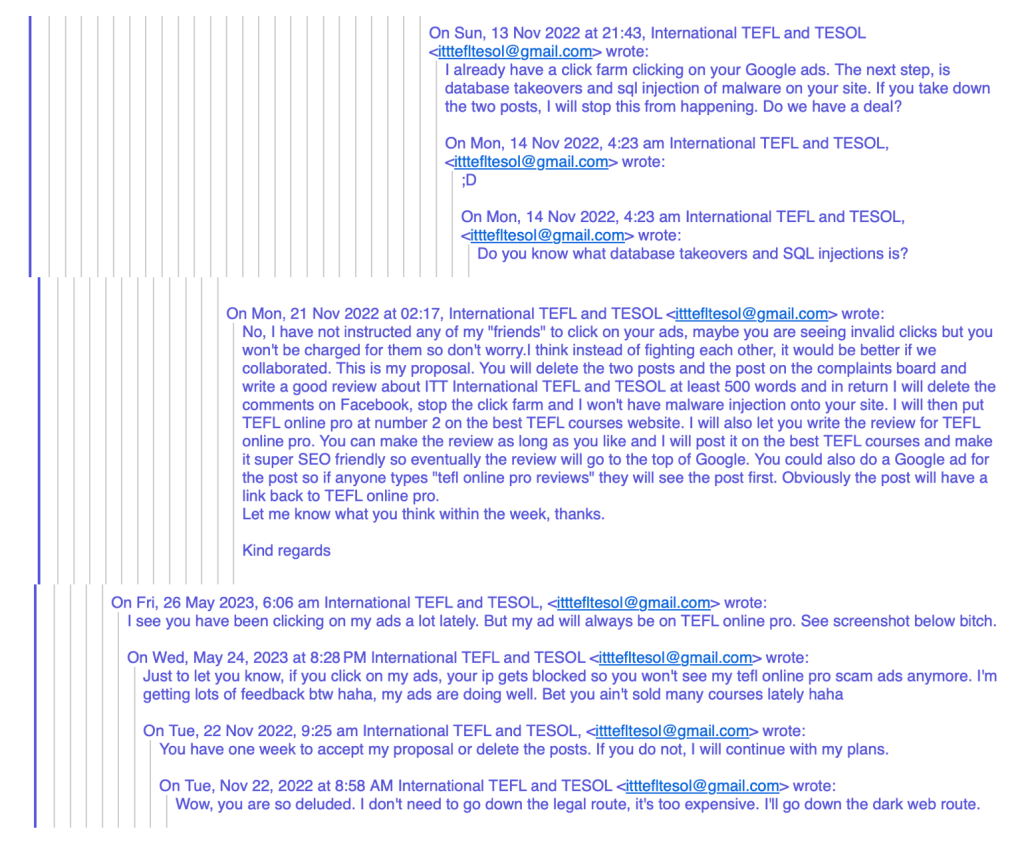
I am publishing these records because readers should understand the commercial environment in which online TEFL reviews are sometimes produced and promoted. The screenshots let you examine the original messages and reach your own conclusions.
Identification and police report. For clarity, the official school email address published by ITT International TEFL and TESOL Ltd. is contact@internationaltefltesol.com, but the correspondence above also came from a general Gmail address, itttefltesol@gmail.com. Through evidence gathered in our enquiries, we have established that James Anthony Dwyer sent messages from both addresses. Using a general Gmail account does not change the evidence about who the sender was.
We have reported the matter to the UK police, and a criminal investigation is ongoing. We will not prejudge its outcome.
What this costs
Sayre’s Law does not fully capture this part. Content like this does not stay in a quiet corner of the internet. A prospective student searches for “TEFL Online Pro review,” finds a blog post or Reddit thread that looks like independent advice, and uses it to decide where to spend their money. If the author has an undisclosed link to a competing provider, the reader may lack what they need to evaluate that advice.
We believe negative content of this kind has cost us business. We cannot reliably put a figure on the effect of any single post, and we cannot know what each prospective student thought on seeing it. But the possible consequences are real.
People weighing a TEFL qualification may be spending their savings, planning a move abroad or starting a new career. Their decision deserves accurate information and transparent recommendations. A $20–60 commission may be small to the person earning it. For a student deciding about their future, misleading or incomplete information can matter far more.
And if an affiliate network is used to spread damaging claims while hiding the commercial context, the harm goes beyond the immediate target. Readers lose the chance to judge the content fairly, and businesses end up defending their reputations against claims that circulate without the context needed to assess them.
That is why I wrote this: not to say competitors should never criticize each other, but to argue that commercial relationships should be visible and factual claims should be supportable.
ESLinsider: who runs the “authority” site?
When you assess TEFL content, it also helps to ask who operates the website and what they sell.
ESLinsider is a blog and online TEFL training business associated with Ian Patrick Leahy. Someone searching for provider reviews might land on an informative-looking article there and assume the author is an independent observer. But a site that publishes reviews while selling its own TEFL training has a commercial interest in the market it covers.
That does not make its content invalid. A business owner can write a fair and accurate review of a competitor. What matters is whether the information is fair, the evidence is sound and the reader has enough context to judge the author’s perspective.
When you evaluate any review site, I suggest checking:
- Who owns and runs the site?
- Does the author sell a competing course?
- Are the review criteria explained?
- Is any claim about accreditation backed by evidence?
- Does the article separate documented facts from opinion?
- Are commercial relationships disclosed?
I would put the same questions to ESLinsider, to The TEFL Academy and to TEFL Online Pro. No provider should escape scrutiny just because it publishes the review rather than being its subject. The commercial context is worth knowing, but it is no substitute for examining the evidence. Further detail and supporting evidence about ESLinsider are available in the TEFL Online Pro Transparency Report.
A word on “free” TEFL courses
Free TEFL courses are heavily advertised, and some give a useful introduction to teaching English. But “free” does not tell you what the product really is.
This article from Trusted TEFL Reviews covers most of the key points about one well-known “free” online TEFL program, Teacher Record: Is Teacher Record legit?
In my assessment, with a program like this you are the product. As I understand it, the provider earns its revenue by issuing a costly certificate, and does so only once you have agreed to write and publish a very positive review of the course. I also believe that job listings connected with such programs can include discriminatory requirements or advertise one salary and then reduce it once you accept the position.
TEFL Online Pro has publicly criticized this model. Soon afterwards we saw a wave of black-hat SEO links aimed at our site, mostly from a casino website on the domain toeflonline.info. I cannot say who was behind it. I reported the domain to Google, and when I later checked it, the site could no longer be reached. I have not worked out why. Teacher Record is based in mainland China.
Before choosing any course, look at:
- Course content: what will you actually study?
- Assessment: is your learning assessed, and how?
- Accreditation: who accredits the course, and what does that accreditation mean?
- Certificate recognition: will the certificate satisfy the employers or institutions you have in mind?
- Commercial arrangements: are there fees, conditions or employment-related obligations beyond the advertised price?
Do not assume a course is good because it is free, or that a paid course is automatically better. Compare the content, recognition and terms.
Why we don’t routinely ask students for reviews
We do not routinely ask our students to leave reviews. We would rather they decide for themselves whether to share their experience. As a result, our review count can grow more slowly than that of a business that invites every customer to post. Many satisfied graduates simply finish the course and get on with their lives.
The reviews we receive come from people who chose to write them. That does not make every review representative, and it does not mean critical feedback should be dismissed.
It is also worth studying the pattern of reviews for any provider. If a business collects a cluster of five-star reviews on a single day, a reader may fairly wonder how they were generated. Timing alone proves nothing improper, since reviews may be requested in batches and genuine customers may post around the same time. But it can raise real questions about the legitimacy of some providers’ reviews.
The lesson is not to assume wrongdoing. It is to look at the wider context rather than treating a star rating or review count as proof of quality. We prefer to let our customers speak for themselves, and we encourage prospective students to consult several sources before they decide.
Don’t take our word for it
This article has covered negative reviews, brand ambassadors, affiliate marketing and the need for transparency. But what do people who actually took our courses think?
Since 2019, graduates of TEFL Online Pro have left feedback on many platforms. Rather than asking you to trust me on course quality, I invite you to read their reviews and form your own view.
- Annelise is starting as an English Teaching Assistant with Fulbright Austria, which her TEFL Online Pro certification helped make possible.
- Noor explains in her follow-up review how her certification has been essential for teaching online and in South Korea.
- Clara reports in her follow-up review that her certification prepared her to teach online and in Barcelona.
Where to read reviews and other sources
- Trusted TEFL Reviews: https://trustedteflreviews.com/category/tefl-online-pro-reviews-best-tefl-tesol-certification/
- Facebook reviews: https://www.facebook.com/teflonlinepro/reviews
- Google reviews: https://g.page/r/CWQMRorxD2gfEAI/review
- YouTube: https://www.youtube.com/@teflonlinepro
- Cambodia Bucket List: https://cambodiabucketlist.com/tefl-online-pro-reviews
No single review platform tells the whole story, and feedback should always be read critically. The fairest approach is to look at the available evidence, consider different viewpoints and make up your own mind.
A six-question checklist for reading TEFL reviews
Before you rely on any TEFL review, ask:
- Who wrote it? Is the author identifiable, and can you check their background?
- Do they sell a competing course? If so, does the article say so?
- Is there an affiliate link or ambassador relationship? Look for a clear disclosure of relevant commercial interests.
- What does “accredited” actually mean? Check who the accrediting body is and how far its recognition extends. Accreditation, regulation and employer acceptance are different things.
- Can the claims be verified? Look for original records, dates, documents and evidence that supports the conclusion.
- Does the author acknowledge uncertainty? A credible review separates what is documented from what is alleged or inferred.
These questions apply equally to favorable and unfavorable reviews, to small providers and large ones, to independent bloggers and to businesses that sell courses themselves.
They apply to us, too. TEFL Online Pro has a commercial interest in how prospective students see our courses. That is exactly why I stated my position at the start of this article and linked to the underlying report. I am asking you to examine the evidence, not to accept a statement because it comes from me.
Small stakes, serious damage
Step back and consider the whole picture: a possible $20–60 commission, a blog post, a Reddit thread, a brand ambassador whose commercial tie goes unmentioned, and a competitor that may be able to distance itself from content published by someone else.
Each incident can look trivial on its own. But repeated content can shape search results, sway prospective students and affect a business’s reputation long after the original page has disappeared. For the writer, the immediate incentive may be small. For the student who relies on that writing, the stakes may be their savings, their career and their plans to live abroad.
The problem is not affiliate marketing, not criticism and not competition. The problem is that readers can be handed what looks like independent advice without the context they need to assess it. When commercial relationships are hidden, people decide with incomplete information.
If affiliate networks are being used to deliver competitive attacks while the commercial context stays hidden, the harm reaches well beyond the people directly involved. That conclusion, though, has to be tested against the evidence in each case, not assumed because a relationship exists.
Sayre’s Law is a useful lens for the gap between a small immediate incentive and the energy spent on a dispute. The more important lesson is that the consequences are not necessarily small for the targets or for the readers who rely on the resulting content. The cost of low-stakes behavior does not vanish. It may simply be paid by someone else.
If a review has a commercial context, readers deserve to know it. If a company is involved in a campaign against a competitor, that involvement should not hide behind the apparent independence of third parties. And if we make serious allegations, we should be ready to show the evidence.
That standard should apply to every provider in the TEFL industry, including mine.
The next time you read a strongly worded TEFL review, check for a disclosure, find out who is behind the website, and ask whether the claims can be independently verified. A review can be critical and still be fair. It can be commercially motivated and still contain useful information, or it can simply be a competitor’s sicario hit job. Either way, readers deserve to know the context, and serious allegations deserve evidence.
Disclosure
I own TEFL Online Pro and earn income from it. I also have more than 25 years of hands-on experience in TEFL/TESOL certification and teacher training, including developing on-site and online certification programs and writing articles for Cambridge University Press.
That gives me extensive practical knowledge of course development, certification and the online teacher-training industry. This article reflects my perspective as both an industry professional and the owner of a company discussed in it, and it should not be read as independent commentary. Where allegations are disputed, I have said so.
If you’d like to know more about the person behind TEFL Online Pro, you can find me on my personal blog.
The full report and supporting material are in the TEFL Online Pro Transparency Report.
Neville David Thomas
Do you agree or disagree with anything raised here, or have information or a different perspective to share? Please leave a comment below. Constructive discussion is welcome.
