

Congratulations on successfully passing the sixth module! 🙂
In this Grammar Review (2) seventh course module, we will be taking a look at (7.1) Modal verbs, (7.2) Prepositions and particles of speech, (7.3) Articles – Definite/Indefinite. It is essential that you thoroughly read through all the information presented within this module, before then completing the Module Quiz and proceeding to the eighth module. If you have any module-related questions, please contact your personal tutor through the CONTACT LESSON TEACHER button. Good luck and we hope you enjoy completing your seventh module! 🙂
(7.1) Modal verbs.
Modal verbs are auxiliary verbs that express certainty, necessity, obligation, possibility and probability. Modals verbs are also utilized as language functions when talking about ability, asking permission, making requests and offers, etc.
The modal verbs and semi-modal verbs used in the English language are:
Can | Could | Be able to | May | Might | Shall | Should | Ought to | Will | Would | Must | Have to | Need to | Don’t have to | Needn’t |
We are now going to look at each modal verb grouping; identifying their usages and grammatical functions.
Can, Could, Be able to.
Can, Could, Be able to, are used to express ability/lack of ability, possibility/impossibility, asking/giving permission, making suggestions.
Ability/lack of ability examples:
- John can play the guitar.
- Sally can’t eat dairy products.
- He is able to run a minute mile.
- She won’t be able to come to the party.
Please note that the past tense of these modal verbs are formed by Could / Couldn’t / Was / Wasn’t / Were / Weren’t / Hasn’t / Haven’t /.
- When I was younger, I could / couldn’t eat anything I wanted.
- He was / wasn’t able to catch the train in time.
- They were / weren’t able to complete the game in time.
- She hasn’t been able to reach her boyfriend all day.
- We haven’t been able to do any work all day.
Possibility/impossibility examples:
- You can succeed if you work hard.
- She can’t see you right now. She’s ill in bed.
- I could walk to Spain if I really wanted to.
Asking/giving permission examples:
- Can you lend me your car for the weekend?
- You can come to the party.
- Could I have your contact information?
Making a suggestion example:
- You could lose more weight if you cut out the chips.
May, Might.
May and Might, are used to express formal permission/formal prohibition, polite requests, possibility/impossibility, making suggestions.
Formal permission/formal prohibition examples:
- You may begin the test now.
- You may not wear a t-shirt to the dinner party.
Polite requests example:
- May I help you look after the children over the weekend?
Possibility/impossibility examples:
- We may go swimming this afternoon. Do you want to join us?
- Our school might get the funding if the budget allows for it.
- Adam may not buy that apartment. It has structural issues.
- He might not buy an apartment at all.
Making suggestions examples:
- You may as well come inside. Fiona will be back soon.
- I might as well forget all about traveling the world. I am broke.
- You might like to try the Vouvray. It’s a wonderful wine.
Shall, Should, Ought to.
Shall, Should and Ought to, are used to express offering of assistance/polite suggestions, predictions/expectations, giving advice.
Offering of assistance/polite suggestions examples:
- Shall we eat out tonight?
- Should I make a reservation?
- The apartment should be completed on time.
Predictions/expectations example:
- I shouldn’t be late. The airline is usually punctual.
Giving advice examples:
- You should check the apartment contract before signing.
- You ought to visit a dentist with your bad tooth.
- Miranda shouldn’t treat her children like that.
Will, Would.
Will and Would, are used to express polite requests/statements, habitual past actions.
Polite requests/statements examples:
- Stela will meet you later today.
- Keith won’t be happy with the results of the test.
- Will you please leave the door open for me?
- Would you mind if I stayed for a few days?
- I would like to apply for the Manager’s position.
Habitual past actions examples:
- When I was a child, I would spend hours painting in my room.
- Clive wouldn’t drink milk when he was a child.
Must, Have to, Need to, Don’t have to, Needn’t.
Must, Have to, Need to, Don’t have to and Needn’t, are used to express necessity/requirement, certainty, persuasiveness, prohibition/forbidden, lack of necessity.
Necessity/requirement examples:
- You must have a visa to visit Russia.
- Svatava has to apply for her visa by the end of the month.
- I need to take this book back to the library.
- I had to leave work early yesterday.
- I needed to drink a Bloody Mary this morning to feel human again.
Certainty example:
- Kevin has lived in Prague for 20 years. His Czech must be excellent.
Persuasiveness examples:
- You must visit Barcelona. It is a wonderful city.
- You have to visit the newly-opened restaurant in town.
Prohibition/forbidden examples:
- You must not drink and drive!
- You mustn’t leave chemicals where children can reach them.
Lack of necessity examples:
- You don’t have to wear a suit. It’s going to be a casual affair.
- Xander doesn’t have to study German this school year.
- You didn’t have to scream. We could all hear you.
- You needn’t worry about Simon. He will be just fine.
(7.2) Prepositions and particles of speech.
A preposition is a word which usually governs and precedes a noun or pronoun, and expresses a relationship to another word or element in the clause, for example: ‘the woman is in the car’, ‘she arrived after dark’, ‘what did you want it for?’.
The English language has many prepositions, and the following table – containing the most commonly-used prepositions – will provide you with an overall idea as to what it means for a word to be classed as a preposition:
| about | below | excepting | off | toward |
| above | beneath | for | on | under |
| across | beside(s) | from | onto | underneath |
| after | between | in | out | until |
| against | beyond | in front of | outside | up |
| along | but | inside | over | upon |
| among | by | in spite of | past | up to |
| around | concerning | instead of | regarding | with |
| at | despite | into | since | within |
| because of | down | like | through | without |
| before | during | near | throughout | with regard to |
| behind | except | of | to | with respect to |
In this section of the module, we are going to look at one particular set of prepositions: Prepositions of Time. And we are going to look at just three prepositions, to illustrate how you can effectively teach prepositions in your classes:
In | At | On |
Let’s begin by introducing some nouns, which we will be using for this example activity:
Saturday | April | 2020 | Birthday | Yesterday | Tomorrow | Noon | Midnight | Summer | Weekend | Morning | Christmas | 4 o’clock | Dawn | Sunset | Next week | Fortnight | Black Friday | Night |
Now, let’s present this information as a whiteboard class activity:

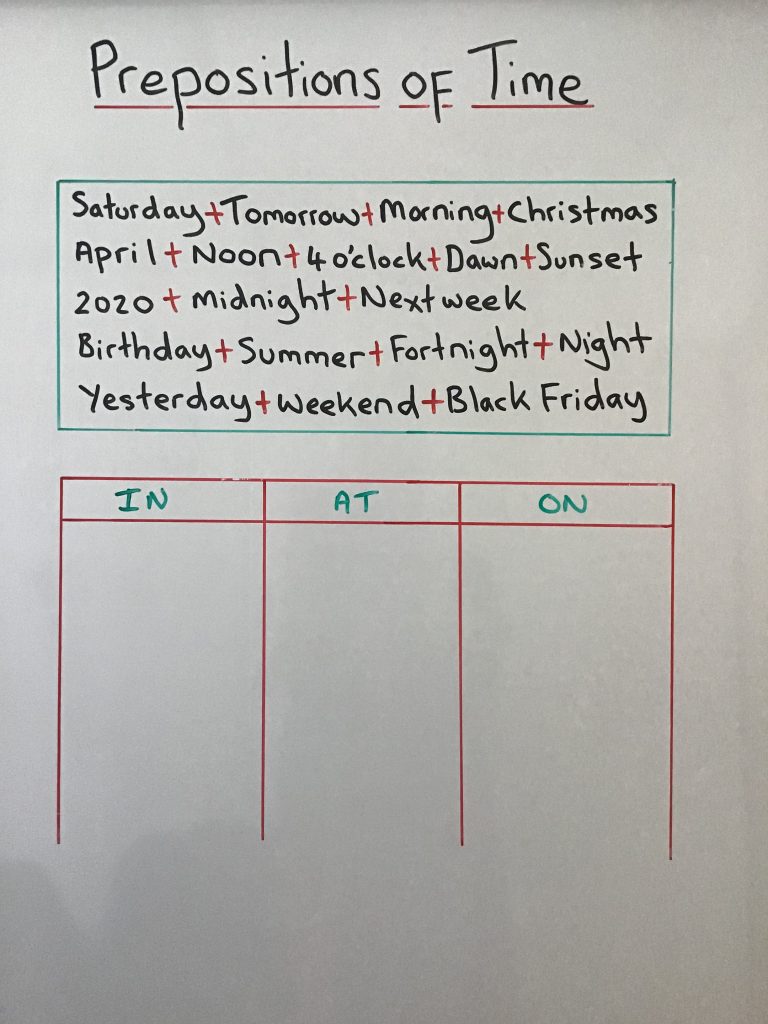
The second part of this activity will be for the students to step up to the board and decide which noun goes with which preposition. This is the (trial and error) Practice stage of the lesson. The correct answers should look like so:

(please note here that in British English, the preposition ‘At’ is used in connection with the noun, ‘Weekend’).
As you can see, three of the Prepositions of Time haven’t been included on the table because they are not preceded by a Preposition of Time (‘Tomorrow’, ‘Next Week’ and ‘Yesterday’).
It would be very unusual for the class to guess all the correct answers, so this complete table is a result of corrections to the table contents.
The next step will be to ask learners what they think the grammar rules are for using ‘In’, ‘At’, ‘On’ as Prepositions of Time.
The answer is that ‘In’ is used for longer periods of time, ‘At’ is used for specific times and ‘On’ is used for days.
A Production activity could involve the learners thinking of other time-related nouns and also adding them to the table.
Particles of speech.
A word that looks like a preposition but is actually part of a verb is referred to as a Particle of Speech.
An example sentence: ‘three aggressive men held up the store’.
‘Held up’ is a verb, meaning ‘to rob’. Therefore, ‘up’ is not a preposition, and ‘store’ is not the object of a preposition. Instead, ‘store’ is the direct object of the verb ‘held up’.
You can avoid confusing prepositions with particles with a simple test. Try moving the word ‘up’ and the words following it to the front of the sentence: ‘up the store three aggressive men held’.
If the resulting sentence doesn’t make any sense, then the word belongs with the verb and is a particle, not a preposition.
(7.3) Articles – Definite/Indefinite.
In the English language, there are three articles: ‘a’, ‘an’ and ‘the’.
Both ‘a’ and ‘an’, are referred to as being indefinite articles, and ‘the’ is the definite article.
Articles are used before nouns or noun equivalents and are a type of adjective. ‘The’ is used before a noun to indicate that the identity of the noun is known to the reader. ‘A’ and ‘An’ are used before a noun that is general or when its identity is not known.
The method of knowing when to use each article appropriately, is to follow these three simple rules:
- ‘The’ is placed before a singular or plural noun.
- ‘A’ is placed before a singular noun beginning with a consonant sound.
- ‘An’ is placed before a singular noun beginning with a vowel sound.
So, for example:
- ‘The pen is on the table’.
- ‘A hat protects you from the sun’.
- ‘An umbrella protects you against the rain’.
Students often understand these grammar rules with ease, but experience difficulties when it comes to situations when indefinite articles are replaced by definite articles when describing the same object. Such as:
‘I drank a glass of water this morning. The glass of water was lovely’.
In this example sentence, we begin using the indefinite article ‘A’ because it is placed before a singular noun beginning with a consonant sound. However, once the noun has become established (in other words when it has already been mentioned) we then refer to it by using the definite article.
Please also note that we don’t use any articles before proper nouns (such as countries, for example). We also don’t use indefinite articles when describing uncountable nouns, but we can add an article by inserting a quantifier. So while it isn’t possible to say that you would like an oil, it is possible to say that you would like a can of oil. The quantifier in this sentence is, ‘can’.
The following are some examples of article usages:
- I do not want a dog in my house (any dog).
- The knife is in his garage (suggests there is a specific knife).
- I’m afraid of knives (all knives in general). Hence no article.
- He sent me a letter from Spain (an unspecific letter).
- It is the letter that I have in my office (one specific letter).
- Receiving letters makes me feel happy (any letter in general).
- I have a cat (one cat).
- The cat is very loving (the cat that I have already mentioned).
- Cats make fantastic home pets (cats in general).
- Lucy needs new furniture for her house (furniture is an uncountable noun).
- She is going to choose the furniture that she needs (the specific furniture that she needs).
- We are visiting Canada next week. (proper noun).
- We are visiting the Czech Republic next year. (countable: ‘Republic’).
There are many specific rules when not to, or when to add articles – such as when referring to geographical features – and the list is far too extensive to list here in this module. We have covered the essentials and if you are asked a difficult question regarding articles in your class, we advise looking up the specific article rule for that specific noun or pronoun term.
Congratulations on reading through the seventh module!
Now it’s time to take the Module 7 Quiz, after which you will gain access to the eighth module.
Important! We recommend reading through the seventh module again to ensure that you are fully prepared to take this quiz.
Click on the VIEW THE LESSON QUIZ button to proceed to the Module 7 Quiz…