

Congratulations on successfully passing the first module! 🙂
In this Grammar Review second course module, we will be taking a look at (2.1) Teaching grammar communicatively, (2.2) Tenses and time, (2.3) Conditionals. It is essential that you thoroughly read through all the information presented within this module, before then completing the Module Quiz and proceeding to the third module. If you have any module-related questions, please contact your personal tutor through the CONTACT LESSON TEACHER button. Good luck and we hope you enjoy completing your second module! 🙂
(2.1) Teaching grammar communicatively.
The Communicative Approach or Method is based upon the concept that the ability of successfully learning a language develops through communicating real meaning, and that when learners are involved in real communication, their natural strategies for language acquisition will be used, and this will facilitate them with learning to use the language.
So, communication is key! And I imagine that the vast majority of you reading this module content will agree with this statement. Language classes should be communicative, and we should be mindful in making sure that we include enough communicative activities in our lessons, and that grammar should also be taught communicatively (despite having traditionally been taught non-communicatively for many years past).
Teaching grammar communicatively does have its challenges, but we are going to explain how it can be done effectively.
It seems obvious that speaking exercises and classroom activities should involve communication, but teaching grammar in a way that puts an emphasis on this aspect appears at first more of a challenge. However, it is not nearly as difficult as it sounds. In fact, it actually makes grammar teaching a lot more efficient and effective. The key to communicative grammar is presenting language in a manner that corresponds with the ways that our brains process and encode language, rather than lists and explanations that decontextualize grammar and make it an un-relatable grouping of rules that seemingly have nothing to do with the way we actually think.
We have ideas of what we want to express in our minds, but we certainly don’t store them as lists, arranged by their grammatical properties. We store information in our minds in terms of concepts. This is our knowledge of the world, past experiences, what we believe to be true, etc. However, because we need a way to express these meanings and information to other people, we encode them in language. The specific things that we want to do and express with language are called Speech Functions. These functions are then encoded into specific linguistic forms, which we commonly refer to as grammatical forms. The most important part of understanding the Communicative Approach to grammar is that specific concepts are linked to specific grammatical forms in our minds.
We can see this in the ways in which different languages conceptualize the same functions by using different grammatical forms.
Let’s take a bar or pub scenario as a wonderful example, and let’s do away with all the usual polite language structures:
In English, we might say, “I’ll have a beer”.
This sentence communicates that there is a sense of the future that we can see in the use of ‘will’, although it’s definitely not the distant future.
If we express the same thing in German, we could say, “Ich nehme ein Bier”.
It’s the same mental concept, namely being that I’m thirsty and the thing that I want is a nice, cold beer, but the German version projects more of a sense of immediacy.
This is what is meant by different forms for the same (or a similar) concept in different languages. But how does this apply to teaching grammar in the English language classroom?
As an example, let’s think about the way students in English classes throughout Austria learn the Present Continuous tense – formed with the subject plus the Present Particle form (-ing) of the main verb and the Present Continuous tense of the verb to be: am, is, are.
It’s more difficult than the Present Simple tense, which has a German equivalent so how do you get students to internalize a concept that, until it is introduced to them, doesn’t exist in their minds as a separate function? A teacher who subscribes to traditional views of language teaching would probably present the form along with a list of rules of when to use it (i.e. all of the functions associated with the grammatical form).
The issue though with this system, would be that this teacher is giving their students all of those functions (those concepts in our brains) at the same time and expecting them to learn and use them all simultaneously. For the student, these functions tend to blend together into a vague idea of when to use the –ing form of the continuous tense, and it will probably take a lot of trial and error, as well as years of practice, to really figure it out properly.
What communicative grammar does differently is that it limits the amount of information presented to students by staggering the teaching of the individual functions. If we were teaching the Present Continuous, we might start with the notion of present activity. We would introduce the form as it is used in natural speech, and in a way that alerts them to the fact that there is something different about this new form. This stage of learning is called the Awareness-Raising Stage, where learners are looking for patterns in the target language.
So to begin with, we refrain from telling students exactly how the function and form work together until they have had a chance to think about it for themselves. This allows them to activate their own problem-solving and hypothesis-building skills in order to try and figure out how this form and function work together. We would then have students do some activities in order to aid this process of internal rule building, making sure that we are around to guide students in the right direction. This stage is called Conceptualization.
Once the students have come up with a way of explaining the grammatical rule for themselves, the teacher can provide them with the opportunity to really fix this new information in their minds. We want to encourage them to get into the habit of using that –ing form to describe what they’re doing right at that moment, which we will do by presenting them with activities in which they use that form for that specific function in different contexts. We can help this process along by involving students’ personal experiences, memories and personal lives in the activities we plan for the class; this stage is called Proceduralization.
(2.2) Tenses and time.
Regarding the teaching of English grammar, there are three recognized forms of time: past, present and future.
Tenses are grammatical categories which are marked by verb inflections and express when an event or action happens in the flow of time.
It is also important to note that in English, we have two types of verb categories: Regular and Irregular. Regular verbs follow the normal pattern of inflection, and the general rule is that regular verbs form the past tense by adding -ed. Irregular verbs do not follow this pattern. For example, we say ‘wrote’ for the past tense of ‘write’, not ‘writed’.
English verbs are divided into three main forms when related to tenses:
Infinitive / Past Simple / Past Participle.
So, taking a regular and irregular verb as an example:
Play / Played / Played
Sing / Sang / Sung
We are now going to look at each major time tense, via the medium of explanation and simple diagrams.
(A) Past Simple.
The Past Simple is used to show that a completed action took place at a specific time in the past.

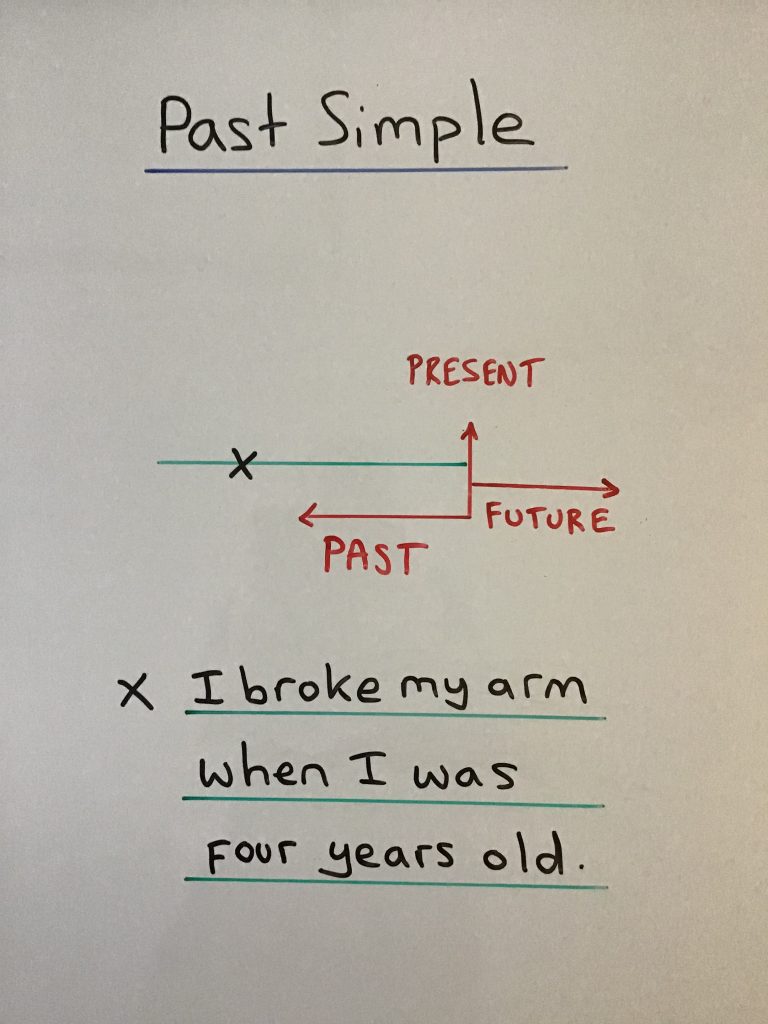
As you can see from the above timeline, I am stating now, in the present, that I broke my arm when I was four years old. The action of breaking my arm happened at a particular time in the past and is complete. Breaking my arm in the past may or may not affect me in the present, but the emphasis is purely about what happened in the past regarding the specific action in a specific time.
(B) Past Continuous.
The Past Continuous is used to to show that an ongoing action was happening at a specific moment of time in the past.

The above timeline shows that in the past, I took part in the activity of playing football. While the Past Simple is used to express a completed action in the past, the Past Continuous emphasizes the ongoing, completed action in the past. This tense is often referred to as being a narrative tense, because it aims to emphasize a period of time in the past which contained action. For example: I went to school yesterday and it was raining. In this sentence, the ‘was raining’ Past Continuous reference emphasizes that prolonged action.
(C) Present Simple.
We use the Present Simple to describe customs and habits, general facts and unchanging situations.

As the timeline shows, the example individual is a teacher and this is something which is a fact and an unchanging situation (at present anyway.) Other examples of the Present Simple could be, I smoke, I play football, etc.
(D) Present Continuous.
The Present Continuous tense indicates that an action or condition is happening now, and may continue into the future.

As we can see in the timeline, at present, I am eating soup. If I eat soup every day, then I could use the Present Simple tense to state that I eat soup every day. But the emphasis here is that I am in the process of eating soup now, and I will most likely still be eating soup in the next few minutes or more further, which means that by nature this tense often overlaps future time.
(E) Present Perfect.
Perfect tenses are very interesting and students often find them extremely difficult to get their heads around, as many languages don’t contain Perfect tenses. To begin with, it is important to note that the term ‘Perfect’ means ‘Past’. So, the Present Perfect tense is really another way of expressing Present/Past. Therefore, the Present Perfect tense is used to indicate a link between the present and the past. It is also vital to realize that Perfect tenses are used to emphasize experience.

The timeline clearly illustrates the relationship between past and present time, but why the two ‘X’ marks in the Past section? This is the experience! This timeline is emphasizing that I went to Paris, spent time in Paris, and that the experience of being in Paris has a link to the present because this experience has some effect on me now. I can still picture the Eiffel Tower for example in my mind. And this is an excellent example of the difference between using the Past Simple and the Present Perfect. If you were to say that you visited Paris, you would simply be stating the fact that you traveled there once and that the act of being in Paris is complete. But if you adopt the Present Perfect tense and say that you have been to Paris, then you are communicating that you experienced Paris and that in some way it has become a part of your present experience of life.
(F) Present Perfect Continuous.
The Present Perfect Continuous tense is used to describe an experience which has recently finished – or maybe is still in process – and the emphasis in using this tense is on the process, as well as the result.

‘I have been painting the wall’, expresses an action which I have been experiencing up until recently and may mean that it is complete or incomplete. A good example of this is if you come into your home and your friend asks why you are covered in paint. To this, you can reply that you have been painting the wall. You could also use the Past Simple and simply express that the action of painting the wall is complete, but when described as an experience, the Present Perfect Continuous tense will apply.
(G) Past Perfect.
The Past Perfect tense (Past/Past) describes an experience which was completed in the past. So whereas the Present Perfect takes the Present as its defining premise, the Past Perfect takes a point in the past as its defining premise. The Past Perfect is similar to the Present Perfect, except that with the Past Perfect, everything occurs in the past.

In this example, the timeline shows that the defining premise is when the person walked and that the experience of learning to crawl occurred before this. As with all Perfect tenses, you can rearrange the sentence clauses so that – in this example – it would make just as much sense if you said that before you walked, you had learned to crawl.
(H) Past Perfect Continuous.
The Past Perfect Continuous tense is used to show that an action started in the past and continued up to another point in the past.

In this timeline, you can see that a crash happened in the past, but before that the person had been experiencing the act of minding their own business. Because it is a Continuous tense, the emphasis is more focussed on the process of the action (‘Minding’.)
The future.
Now let’s look at some of the ways of expressing future time.
(A) Simple Future. This expresses unplanned/spontaneous future and for this tense we use ‘Will’. As an example, you might be ordering food in a restaurant and suddenly decide to add a starter to your meal. Here you would use ‘Will’ to express unplanned/spontaneous future (“Oh, and I will order the starter too”.)
(B) Future Continuous. The future Continuous refers to an unfinished action or event that will be in progress at a time later than now. For example, “I will be skiing in the Austrian Alps next week”.
(C) Future Perfect. The future perfect tense refers to a completed action in the future. When we use this tense we are projecting ourselves forward into the future and looking back at an action that will be completed some time later than now. For example, “By this time next year, I will have lost 10 kilograms”.
(D) Future Perfect Continuous. As with the Future Perfect, the Future Perfect Continuous is used to project ourselves forward in time and to look back. It refers to events or actions that are currently unfinished but will be finished at some future time. For example, “By the end of this year, I will have been living in Bangkok for nearly five years”.
(E) Going to. ‘Going to’ is similar to the Simple Future tense, except that it refers to planned future. For example, “I am going to Oxford next week”. In other words, you haven’t made a spur of the moment decision to go to Oxford, but are going because it is a planned event.
(F) Present Continuous. What! Really? Yes! 🙂 We use the Present Continuous tense also for future time and for super-planned future events. If, for example, you say you are going to play tennis, you are suggesting that it is a planned event. But if you say that you are playing tennis next week, it means that you have arranged and organized everything required to make the tennis match go ahead. So, ‘Going to’ plans can always be either cancelled or postponed, but Present Continuous (future) plans are almost always set in stone.
(G) Present Simple. Come on! 🙂 Yes, we also use this popular tense for expressing future time and we use the Present Simple when referring to future, scheduled events. For example, “The milkman delivers milk every Wednesday”.
(2.3) Conditionals.
Conditional tenses are used to speculate about what usually happens, what might happen, what would happen and what might have happened.
They are formed by combining two clauses (sentence halves) and the clauses can be interchangeable. Conditionals are also linked to probability, as shown below.
There are four main Conditional tense types, and we will take a brief look at each one now:
(A) Zero Conditional. We use the Zero Conditional if wanting to express cause and effect, and for this conditional we can begin the sentence with either ‘If’, or ‘When’. For example: “If or when it rains, I carry an umbrella to work”. Or, “I carry an umbrella to work, if or when it rains”. The probability for this is described as being 100%, because every time it rains, the person takes an umbrella to work.
(B) First Conditional. The First Conditional can be described as a 50/50 conditional, as the effect is dependent upon the cause. For example: “If John asks me out on a date, I will say yes”. The conditional suggests that the possibility of being asked out on a date by John is neither guaranteed, neither unlikely, so therefore the rough estimate of a positive result is 50%. Please note that we can also use “When” with this First Conditional: “When John asks me out on a date, I will say yes”.
(C) Second Conditional. With the Second Conditional, it is no longer possible to use “When” to introduce the conditional, as the probability of the Second Conditional is very low. And because of this, we exchange the ‘Will’ for ‘Would’. For example: “If I won the lottery, I would buy a castle”.
(D) Third Conditional. This final Conditional deals with absolute hypotheticals and combines both the Present and Past Perfect tenses. The probability rating for this conditional is zero. For example: “If I had worked harder at school, I could have been a doctor”.
There is also a fifth Conditional variant, which is referred to as a Mixed Conditional, and this simply means using one type of tense structure in a clause and another in the second clause; creating a ‘hybrid’ conditional. It isn’t mandatory to teach this as part of international TEFL certification course training standards, and we won’t cover this as we don’t want to add possible confusion. We just thought that you should be made aware of its existence.
What we would like you to do now is to please read through the first three conditionals – 0/1/2 and try and identify the grammar tenses contained within each. There is no need to do this with the Third Conditional as we have already identified for you that it is the Present Perfect and Past Perfect tenses).
Congratulations on reading through the second module!
Now it’s time to take the Module 2 Quiz, after which you will gain access to the third module.
Important! We recommend reading through the second module again to ensure that you are fully prepared to take this quiz.
Click on the VIEW THE LESSON QUIZ button to proceed to the Module 2 Quiz…